Showing posts with label no tears. Show all posts

August 19, 2013

A rock and a (regulatory) hard place.*

Watching the state of science over the past 4 years has been simultaneously hope inspiring and heart breaking. Two years ago, I reported that autologous stem cells were being used to cure human corneal blindness. Since then, hundreds of people in India and pockets around the world have benefited from the technique to use a patient's own adult stem cells to successfully cure corneal blindness without risk of rejection! But, this surgery is not available in the United States. It won't even be in clinical trial for a number of years.

Dr. Graziella Pellegrini (interviewed above) developed the stem cell transplantation technique as reported in the New England Journal of Medicine.  

You can probably hear the gnashing of my teeth from wherever you are reading this.

---------------------------------------------------------------------------


*This is a previously unpublished post from May 2012.  At that time, two ophthalmologists recommended that Bertrand undergo surgery to help with corneal scarring.  This surgery, tarsorrhaphy, is disfiguring.  The eyelids are partially sewn together to narrow the eye opening, thus reducing corneal exposure.
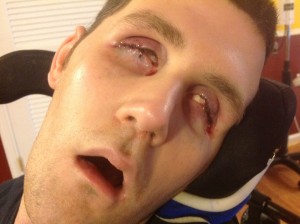
Dear Ryan was among the first google results for tarsorrhaphy.
I was heartbroken. The state of medical science left me in despair.  Bertrand deserved better and I knew it existed, but it was not yet approved in this country.

Due to corneal scarring, Bertrand has reduced corneal sensation and doesn't blink.  If his corneal sensation were restored, we are confident he would be able to blink and retain sufficient moisture on his own.

Unfortunately, a corneal transplant isn't a realistic option until after he reaches adulthood, as children have a ridiculously high rate of corneal transplant rejection.

Yes, we considered taking him to India for the autologous stem cell surgery.

But, short of that, we begged Bertrand's doctors to give us a shot at fighting the corneal erosion.


They did.  ...and it worked.

Today, August 19, 2013, at Bertrand's ophthalmology appointment, the scar on his left eye is no longer visible, and the scar in his right eye is significantly reduced.

Bertrand no longer has to see the doctor every 3 months--just every 6 months.

This miracle of sight is thanks to lotemax (steroid) ointment 3 times a week, systane ointment or refresh drops every 2 hours (minimum), humidifiers, and last, but not least, julbo sunglasses, which reduce ocular surface evaporation and look awesome at the same time.

It's long past time I should publish this, and celebrate.  :)

January 19, 2012

The Happy Mystery


Bertrand is the medical mystery that keeps on giving. Here are two of his most recent puzzles.

The Case of the Disappeared Blink.
At a recent ophthalmology appointment, a doctor noted that Bertrand doesn't blink. His lack of blinking is new. This appears to be the new cause of his corneal erosion. While Bertrand produces tears and can cry now, his corneal erosion has persisted. I immediately flashed to this post by my friend, Carrie, about her daughter Hannah's loss of blink reflex. Lack of blinking is a symptom of Parkinson's disease, with which Bertrand's condition shares some similarities. Blink rate has a direct correlation with dopamine levels. In low dopamine conditions such as Parkinson's, individuals may barely blink. In high dopamine conditions such as schizophrenia, individuals may have a very high blink rate. Certain medications have as a side-effect dopamine reduction and resulting blink reflex loss. The ophthomologist, citing possible drug interaction, decided to write a note to inform Bertrand's neurology team of the finding.

With the neurologists both M.I.A. (yup, the new one is equally unresponsive and Bertrand's EEG has yet to be scheduled), I called my dad. He played the reasonable Watson to my flighty Sherlock. Bertrand's CSF dopamine has tested normal. His movement disorder doesn't present like a low dopamine one. However, corneal sensitivity is what triggers the blink. Both Bertrand's corneas have scarred. Scar tissue is not sensitive. Perhaps it is that simple? We like simple and non-invasive. Bertrand will undergo a non-invasive corneal sensitivity test at his next ophthalmology appointment.

(Regardless, the course of action is lubrication, lubrication, lubrication. Drops don't cut it. Big B is a gel and ointment man. Good times.)

The Happy Mystery
Since Monday, Bertrand has been happy. REALLY happy. Like, perhaps the-happiest-he-has-ever-been-in-his-entire-life happy. Obviously, this is a good thing. And, alert--he stopped taking naps during the day. That is HUGE. However, we don't know what triggered it. And, it bothers me like you wouldn't believe! I lay awake at night trying to figure it out. With Bertrand, we take nothing for granted. If I don't find the root, then I'll keep waiting for the other shoe to drop. We may accidentally mess it up. Or, we could miss the opportunity to make him even happier by doing more of whatever we did right. Neither is acceptable to me. There are a lot of variables, but here are some candidates:
Despite our beloved gastroenterologist's claim that ursodiol is a fairly benign bile salt, it is my primary suspect. This case remains open.

November 26, 2011

Update on Health, Therapy, Diet, & Family

Bertrand & Victoria enjoy snuggling on the couch with Abuelito.

Health:
Bertrand, Victoria and Mama have gotten their first colds of the season. Both kids are staying active and in high spirits in spite of the illness. In Victoria's case, this is her first cold ever and she has handled it like a champ. In Bertrand's case, this is his first real cold since restarting preschool 4 months ago AND he seems to be getting over it as quickly as Victoria and me. This is remarkable! His immune system appears to be doing better than ever.

Therapy:
As mentioned before, we jumped at the opportunity for Bertrand to attend another intensive therapy session at Now I Can. The 2 week session starts on Monday! Because of Daddy's travel, Mama's volunteer commitments and Victoria's cold, Bertrand's Nana is coming to the rescue. She will be taking Bertrand to Now I Can, so I don't lose (more of?) my mind.

Diet:
Since starting vitamin therapy, Bertrand has improved substantially. However, I was concerned about the high quantity of fat soluble vitamins (A & E in particular) that he was receiving. On October 31, his geneticist did me the favor of running levels for vitamins A & E. Bertrand's results were in the low normal range!
Vitamin A 0.36 (normal range: 0.20 - 0.50)
Vitamin E 6.0 (normal range: 5.5 - 9.0)
Why was I excited about this? First of all, this meant that Bertrand wasn't in danger of vitamin toxicity. Secondly, this meant that Bertrand had been extremely vitamin deficient, if after 3 months of vitamin mega-dosing he was just barely in the normal range! We were justified in our concerns.

Since then, Bertrand's vitamin & mineral supplements have been adjusted with the guidance of a naturopath. Bertrand continues to cry tears regularly, even to display emotion, which for us is a great sign!

One of the items which the naturopath brought up in Bertrand's initial examination was the possibility of dairy allergy or sensitivity. So on a lark, I bought some soy milk for Bertrand a week ago. There was noticeable improvement in his breathing and seizure level the next day. And, since then he has been doing very well despite his cold. We're still waiting on the blood test result for dairy allergy which the naturopath ordered, but regardless I will be more insistent when speaking with Bertrand's pediatrician about a referral to an allergist.

Family:
The past few weeks have really underscored how lucky we are to have family close by. Nana, Papa, Titi Saby and Uncle Steve have become vital to the functioning of our family! We loved having Abuelito and Uncle Dan out here for thanksgiving, even if the stay was too short. :) We're already looking forward to seeing them again, and more uncles and aunts, soon!

Standing in front of a gingerbread "house" at the Grand America.

August 20, 2011

Crying Tears.


Bertrand is crying real tears. The only change in his daily regimen has been the addition of a B-12 supplement.

We are using a transdermal B12 patch and oral B12 supplement.

Of course, I've been on a research binge for the past few days. Here are some bits and pieces floating through my head...
  • B12 is stored in the liver. (Bertrand has liver damage.)
  • B12 is water soluble. (An overdose on B12 is near impossible.)
  • B12 is expressed in bile.
  • Actigall (ursodiol) is a bile acid. (Bertrand's liver has improved on actigall.)
  • B12 deficiency in infants causes movement disorder & developmental delay...
When Bertrand was a baby, we'd thought for certain that he was a case of B12 deficiency. His neurologists shot this theory down because of the important fact that Bertrand was/is not anemic. Folate can mask B12 deficiency, but he should still show some signs of anemia.

But this image is haunting me:

The MRI above is from THIS article, entitled "Involuntary Movements and Magnetic Resonance Imaging Findings in Infantile Cobalamine (Vitamine B12) Deficiency", published in PEDIATRICS: Official Journal of the American Academy of Pediatrics back in 2003.

Does "bilateral periventricular symmetric high-signal lesions in the white matter on T2-weighted images" sound familiar?

You can bet this will be discussed with Bertrand's pediatrician on Tuesday!

March 9, 2010

Another tear

Bertrand cried out for "meeehhhh meeehhh" and shed another tear this morning:


He looked very sincere later on:


And showed off his limb-length discrepancy this evening:

March 7, 2010

Tears of the Son

Bertrand seems to have a bug.

He's been having a lot of nasty tonic seizures today, and he's been refusing much of his food.

It's been difficult to comfort him, and he's wailed in pain a couple times.

Yet, there's a "positive" development to come of this: Bertrand cried tears for the first time. Ever. For the first time in two and a half years, we saw tears.

We tried to take some pictures, but they're hard to see on the camera. Look for the glistening streak down his eye.


November 5, 2009

Nightmares and a Negative Test Result

The past few nights Bertrand has been having nightmares. Last night was particularly bad with Bertrand just wanting to be held as he fell back asleep, not put back to bed. Because Keppra may cause nightmares and psychotic episodes in a small number of children, it could be tempting to blame the medication. However, Matthew and I would rather view the nightmares as a sign of progress!--that Bertrand is now cognizant enough to have fears and, therefore, have nightmares. :) Naturally, we will be keeping an eye on the nightmare trend just in case it is a side effect of the medication, but normal children his age have nightmares, so why shouldn't he?

Today I spoke with the amazing Kelly Schoch, Bertrand's genetic counselor at Duke University. Bertrand received a negative test result for a mutation in the AAAS gene. A mutation in the AAAS gene is responsible for 50% of the cases of clinical Allgrove syndrome. While a negative result doesn't rule out Allgrove, Matthew and I aren't interested in chasing down this rabbit hole unless Bertrand begins to exhibit at least one other hallmark symptom (such as achalasia or adrenal insufficiency) in addition to the alacrima. Dr. Stratakis, the world expert on Allgrove syndrome at the NIH, said Bertrand doesn't have Allgrove, so for now, that is fine by me.

One additional option for genetic testing which Kelly presented involves the SCN1A gene. It's crazy how these gene designations are starting to make sense to me, but of course the SCN1A involves sodium channels. (I must of read about it somewhere because it is too weird that this was my first guess.) It is associated with a large range of hereditary seizure disorders and even some hereditary migraines. Duke has a stored sample of Bertrand's DNA, so sending out for the test would technically be easy. However, given that all genetic tests are not cheap, we need to ask, what is the point in knowing this SCN1A result?

For family planning? Not really, because no one else has epilepsy in our families. Bertrand is still most likely a de novo (new) mutation, so it wouldn't be inherited by any of our other children. For treatment? Not really, because we're already implementing the ketogenic diet and treating the seizures in the same way one would in the case of a SCN1A mutation (with liver issues). For plain old knowledge? Bertrand is our son and we love him more than anything in the world--that's all the knowlege we need. No test result will change that.

April 14, 2009

Skin Biopsy, Pharmacy, Lab Work & More

Bertrand saw Dr. Longo this morning for a skin biopsy. After applying local anesthesia to the area, Dr. Longo took a pencil eraser sized chunk out of Bertrand's right buttock. Bertrand slept through the actual biopsy portion. This is of course after he pooped on the table and proceeded to pee all over Dr. Longo's nice white lab coat. That about covers what Bertrand thought of the entire experience. ;)

After that Bertrand and I went on the great seizure medication quest. Two more pharmacies and still no meds. His prescription calls for a non-standard dosage because he is small. This has caused me grief. Finally, the University of Utah hospital pharmacy said they could make them... by Thursday. It's a good thing Bertrand doesn't actually need them yet!

After that we were off to the outpatient lab. And, yes. My son, he has the stigmata. They had to poke 4 times (both hands and both arms, no feet this time) to get all the blood they needed. We got two of our favorite lab techs (Joel and Renee) since it takes three people to hold Bertrand down. As tough as it was, we managed to get a lot of smiles from Bertrand--and draw the blood.

The labs (many are repeats) and expected turnaround times are as follows:
  1. Copper: 1 week
  2. Ceruloplasmin: 1 week
  3. CLN1 & CLN2: 1 week
  4. ACTH*: 1 week
  5. GM1 (Seattle): 7-10 days
  6. Arylsulfate (Seattle): 2 weeks
  7. Purine Panel (Baylor): 7 days
The skin biopsy will be cultured for 2-3 weeks at the ARUP lab before being sent to the University of Alabama. From then it'll take an additional 2-3 weeks to run the tests.

*Adrenocorticotropic hormone (ACTH or corticotropin) is a test I requested.

Last Saturday Bertrand rolled off the bed, got hurt and cut his lip. He was screaming so loud and hard that his face was blue, but there were still NO TEARS. I finally had enough and spent a day researching that condition; it's called alacrima. It ranges from no tears to blistered corneas and can be caused by very few things, one of which is called Allgrove syndrome.

Allgrove is another VERY rare genetic condition. It is also called Triple A Syndrome because it is characterized by Alacrima, Achalasia (difficulty swallowing) and Adrenal deficiency. We know Bertrand has difficulty swallowing and choking--his swallow study is next Tuesday. The ACTH would measure the adrenal (un)responsiveness, which is why I want the result.

People with Allgrove can have ataxia, movement disorder, neuropathy, optic nerve atrophy, developmental delay, abnormal EEG, small head for height... all of which Bertrand has. About the only thing he doesn't have is failure to thrive--his "problem" with a lot of tentative diagnoses. :) Most interestingly, it disproportionally affects Puerto Ricans! This is the first disease for which we have a known genetic basis.

Treatment for Allgrove would be relatively simple: a steroid like prednisone. (And of course extensive therapy to try to work around the damage which has already occured.) However, it is worth keeping in mind that alpha-fetoprotein, ALT, AST, and oligosaccharides should all be normal for Allgrove. These are all elevated in Bertrand. Regardless, I am fostering that evil little emotion called hope again. :)