November 9, 2009

Facebook offers parenting tips

I guess facebook realized I've been a little busy lately, and kindly offered this parenting tip with their "Suggestions" feature:


From now on, when I feel like connecting with Bertrand, I can just write on his wall.

Beats changing diapers.

UPDATE: Apparently, Facebook takes issue with my parenting style as well. --Cristina

One More Week!

By this time next week Bertrand will have started the ketogenic diet! The few weeks we've had to prepare have been invaluable. While many parents feel scared and unprepared when their child starts the diet, I feel calm and centered because I had the time to: read all the recommended books, research all the right websites, join the appropriate newsgroups, order & watch the available videos, talk with experienced KD people, buy all the supplies, practice making keto recipes, etc. Also, I found out that the reason Bertrand couldn't start the diet sooner was because Paula Peterson FNP, who is initiating his diet, is attending the "Dietitians’ & Nurses’ Forum on Dietary Therapies for Epilepsy" this week! Amusingly enough, the forum, which is run by the Charlie Foundation, is taking place this year at the Doubletree Paradise Valley Resort in Scottsdale, Arizona--where Matthew's senior prom took place. :) I am glad that Bertrand will have the benefit of this latest and greatest knowledge on the ketogenic diet moving into his initiation! Everyone, keep your fingers crossed!

November 6, 2009

HIV-based gene therapy effective for a lysosomal disorder

Scientists in France have used a disabled HIV virus to deliver corrected genetic code into the blood of X-linked adrenoleukodystrophy patients for the first time. Gene therapy, in which a patient's DNA is modified to correct genetic defects, has long been a holy grail of medicine, but it has been difficult in practice. To make gene therapy work, you have to replace the DNA in every cell that's affected. The problem with this is that the process of modifying all those cells too quickly can easily kill the patient. One mechanism for inserting new DNA is to use a modified virus [since a virus is little more than parasitic syringe for DNA], but with that route, it's important to control the rate at which the virus spreads. This is encouraging news, because if HIV proves a safe and effective carrier for new genetic material, it could be applicable to a range of diseases hypothetically treatable with gene therapy.

November 5, 2009

Nightmares and a Negative Test Result

The past few nights Bertrand has been having nightmares. Last night was particularly bad with Bertrand just wanting to be held as he fell back asleep, not put back to bed. Because Keppra may cause nightmares and psychotic episodes in a small number of children, it could be tempting to blame the medication. However, Matthew and I would rather view the nightmares as a sign of progress!--that Bertrand is now cognizant enough to have fears and, therefore, have nightmares. :) Naturally, we will be keeping an eye on the nightmare trend just in case it is a side effect of the medication, but normal children his age have nightmares, so why shouldn't he?

Today I spoke with the amazing Kelly Schoch, Bertrand's genetic counselor at Duke University. Bertrand received a negative test result for a mutation in the AAAS gene. A mutation in the AAAS gene is responsible for 50% of the cases of clinical Allgrove syndrome. While a negative result doesn't rule out Allgrove, Matthew and I aren't interested in chasing down this rabbit hole unless Bertrand begins to exhibit at least one other hallmark symptom (such as achalasia or adrenal insufficiency) in addition to the alacrima. Dr. Stratakis, the world expert on Allgrove syndrome at the NIH, said Bertrand doesn't have Allgrove, so for now, that is fine by me.

One additional option for genetic testing which Kelly presented involves the SCN1A gene. It's crazy how these gene designations are starting to make sense to me, but of course the SCN1A involves sodium channels. (I must of read about it somewhere because it is too weird that this was my first guess.) It is associated with a large range of hereditary seizure disorders and even some hereditary migraines. Duke has a stored sample of Bertrand's DNA, so sending out for the test would technically be easy. However, given that all genetic tests are not cheap, we need to ask, what is the point in knowing this SCN1A result?

For family planning? Not really, because no one else has epilepsy in our families. Bertrand is still most likely a de novo (new) mutation, so it wouldn't be inherited by any of our other children. For treatment? Not really, because we're already implementing the ketogenic diet and treating the seizures in the same way one would in the case of a SCN1A mutation (with liver issues). For plain old knowledge? Bertrand is our son and we love him more than anything in the world--that's all the knowlege we need. No test result will change that.

November 3, 2009

A Big Boy Day

Normally, I try to limit the number of activities I subject Bertrand to on therapy days, but happily today Bertrand proved that my over-protectiveness is no longer necessary! He handled six crazy errands and then his occupational therapy at Shriners Hospital like a pro. At one point I was holding him on my hip at Ace Hardware, talking to him about paints and enamels (he wanted a yellow spray paint can but I explained to him that we needed clear enamel spray) and he was so engaged, it felt like I had a normal baby. He sat on the counter, flirted with the cashier and "helped" me check out. He was so well behaved all morning and afternoon that I thought he'd certainly fall apart at therapy. Bertrand proved me wrong! At the start of therapy he communicated he was thirsty WITH A SIGN (not a fuss!), drank, and proceeded to have a fuss free therapy session! He is now taking a well-deserved nap, and I can't help but feel so proud of my big boy. Days like today give me hope for tomorrow. :)

November 2, 2009

Review: "The Ketogenic Diet"

A few days ago I read The Ketogenic Diet: A Treatment for Children and Others with Epilepsy by John M. Freeman et al. The authors are members of the Johns Hopkins team which has developed, preserved and championed the ketogenic diet. The book is in its fourth edition and, after reading it, I can see why it is required reading for almost everyone commencing the ketogenic diet. I highly recommend it to anyone interested in learning more about this alternative, non-alternative treatment for epilepsy!

Due to decades of scientific research done on the effectiveness of the ketogenic diet, the authors stress that it is not to be viewed as “alternative” medicine. The diet IS traditional western scientific medicine. The mechanisms that grant the diet’s effectiveness are as well understood as (and even more well studied than) the mechanisms which govern modern seizure medication’s effectiveness. Sadly, by this I mean, that all epilepsy treatments remain a bit of a mystery to the scientific community.

The book is every book you’d want or need to start the ketogenic diet rolled into one. It covers the history of epilepsy and the ketogenic diet. It attempts to explain the possible biological and chemical mechanisms at work in the ketogenic diet and even the very promising, modified Atkins diet. The Calculations section is basically a workbook, which leaves one more confident about being the sanity check for your dietician. The recipes (both Ketogenic and Atkins) are excellent, and in this section and through out the book, the diet’s use in infants is heavily covered! Lastly, the book is peppered with anecdotes and examples drawn from a vast pool of humanity, which bring the content to life.

While the book is forthright on the limitations and expectations one should have regarding the ketogenic diet (I am now back to being pessimistic about Bertrand’s odds of being helped by the diet), I was heartened by a section entitled “Speculation: The Future Role of the Ketogenic Diet.” The authors hypothesize several additional uses for the ketogenic diet outside of epilepsy--the one that caught my eye was as a treatment for cancer. If I ever get cancer (brain cancer in particular) I have nothing to lose by trying this experiment!
“Brain tumors appear to feed on glucose. Indeed they “steal” glucose from the surrounding brain tissue, causing the surrounding tissue to die. Whereas normal brain tissue can use ketones such as beta-hydroxy butyric acid (BOH) as an energy source, tumor tissue does not appear to have the ability to metabolize ketones... Would it be possible to “starve” a tumor by reducing its glucose supply, while feeding the brain with ketones?”
Fascinating, huh? :)

November 1, 2009

Tracking Seizures

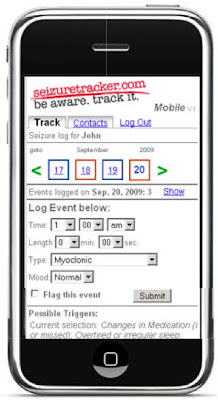
Seizure Tracker iPhone In order to objectively judge the efficacy of the ketogenic diet, we need to find a way to count Bertrand's seizures. This poses a BIG problem because he has several seizures (2 to 6) every minute, even in his sleep. That is close to 6,000 seizures (absence, complex partial with automatisms, drops, and startles) a DAY! (The number of XL spikes and XL events on his EEG are double to triple that, so I am glad I don't have to try and count those!)

Knowing that, is there any wonder why he is so severely developmentally delayed? He can barely follow through on his impulses or commit anything to memory! When I try to count and log all of his seizures, I literally can't do anything else. By the time I'm done checking off the kind of seizure and writing down the duration, he's already had another one and I've missed it. It is very frustrating--but imagine how much worse it must be for Bertrand. :(

Furthermore, due to the nature of his seizures you have to be staring Bertrand in the face--you can't be across the room or sitting on a chair--you have to be on his level at all times. Every eye roll, head jerk, mouthing motion, and meaningless hand movement indicates that a seizure is occurring. I'd gladly stand a 24-hour vigil for B, except that someone has to play with him, feed him, change his diaper, get his books/toys, stroll him, (not to mention, use the restroom, cook, clean, etc.). Besides, it's not fair to seemingly ignore a baby even if it is for his own good.

So, I've been searching for seizure tracking resources. There are all kinds of spreadsheets and programs. One that I thought would be particularly useful is called SeizureTracker.com. Seizure Tracker is a free online program. You can print reports out from it and there is even a mobile version that works well on my iPhone (if AT&T's EDGE network isn't acting up). Furthermore, multiple parties (such as Mom and Dad) can be logged on to the same account thereby automatically syncing the seizure log! Seizure Tracker is fantastic if you've got at least a minute or two between seizures.

Unfortunately for Bertrand, Seizure Tracker proved too cumbersome in the handling of rapid succession seizures. The online nature of the program resulted in seconds wasted waiting for the page to refresh and the inability to log seizures when there was no internet connection (damn you, EDGE!). Also, for our purposes, it was too much of a good thing. There was no option to hide unnecessary values such as "Mood" or "Possible Triggers", which while I'll agree are important, can't be filled out while the next seizure is already occurring.

Simply having a downloadable, offline app of the program which syncs with the online version (for when the network is down) would be a huge improvement. Integrating the app with the iPhone's timer or the computer's built-in clock would also aide in working with rapid fire seizures. And, while I know it asking much of a free program, the ability to hide fields such as "Mood" and "Possible Triggers" would be helpful. However, if you have a child with a more traditional seizure disorder, these aspects may not be as vital, so Seizure Tracker will work great.

So, how am I going to solve Bertrand's seizure tracking issue? I've decided to track his seizures for one hour every day and extrapolate from it. That hour will be from 2PM - 3PM. This time is exactly in the middle of both Keppra doses, so the medication level in his blood should be fairly representative. This is also after his lunch and before his snack, so it should be a good time to observe Bertrand au natural. Using shorthand I'll log his seizures in a notebook, and adjust my logging system as needed. By tracking just this one hour a day we hope to see the effects of the ketogenic diet, and if we're successful with the diet, we can graduate to using Seizure Tracker!